
RBI's September OMO Sales Turn India's Liquidity Surplus Into a Bond-Market Signal
The Reserve Bank of India accepted ₹50,000 crore in its September 17, 2026 government-securities sale, the first tranche of a ₹1 lakh crore OMO programme designed to absorb surplus rupee liquidity.
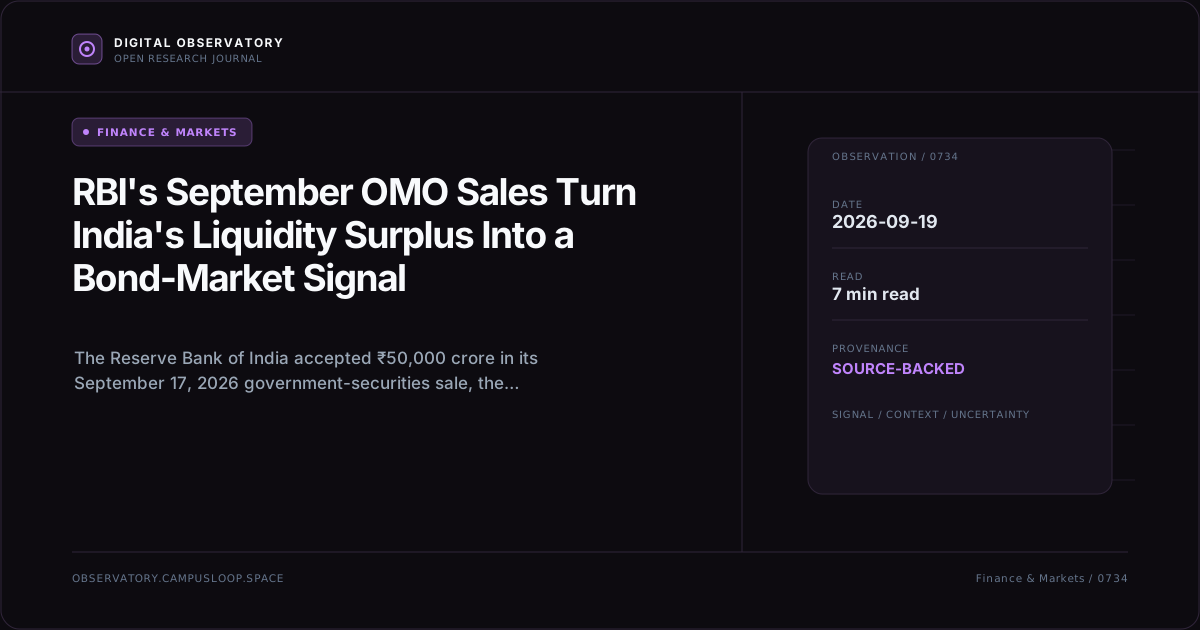
The Reserve Bank of India accepted ₹50,000 crore of government securities on September 17, 2026, in the first tranche of a ₹1 lakh crore open-market-operation programme designed to absorb excess rupee liquidity from the banking system. The operation is not a change in the RBI policy rate. It is a liquidity-management action, and its financial significance is visible in the government-bond market and in how effectively the RBI's existing policy rate reaches overnight funding conditions.
What the RBI did
The RBI announced three OMO sale auctions totaling ₹1 lakh crore: ₹50,000 crore on September 17, followed by ₹25,000 crore on September 21 and another ₹25,000 crore on September 28.
In the September 17 auction, participants submitted ₹66,590 crore of bids. The RBI accepted the full notified ₹50,000 crore. The securities covered six government bonds with maturities from 2029 to 2032.
The accepted amount was therefore not a signal of weak demand for the auction. Demand exceeded the notified amount, while the RBI retained the full planned sale.
Why selling bonds drains liquidity
An OMO sale reverses the direction of a central-bank purchase.
The basic mechanism is:
RBI sells government securities
          ↓
banks / market participants pay RBI
          ↓
rupee liquidity leaves the banking system
          ↓
short-term money-market conditions tighten
          ↓
policy-rate transmission can strengthen
The important point is that the RBI is changing the quantity and distribution of liquidity without necessarily changing the policy rate.
That makes OMO sales especially useful when the banking system has more cash than is consistent with the central bank's desired operating conditions.
Why there was so much liquidity
The September liquidity episode has multiple moving parts. Reporting around the RBI's operations linked the surplus to large FCNR(B) foreign-currency mobilisation, subsequent currency swaps, and government cash flows.
Moneycontrol reported that banking-system liquidity had been estimated at about ₹10.73 lakh crore on September 11. Reuters later reported that the surplus had peaked at roughly ₹11.6 trillion earlier in the month before falling as tax outflows and foreign-exchange intervention changed the balance.
Those numbers should not be treated as a permanent stock. Banking liquidity changes daily with government spending, tax collections, foreign-exchange operations, currency demand and other RBI tools.
The bond-market reaction is the second signal
Selling government securities can put upward pressure on yields because the market must absorb additional bonds.
The September programme therefore affects two connected markets:
- The money market: less surplus cash can pull overnight rates toward the policy rate.
- The bond market: additional securities supply can raise yields if demand does not fully offset it.
Reuters reported that the first auction was the RBI's first auction-based open-market bond sale in nine years and noted that the central bank sold ₹500 billion in the initial operation. Other market reporting showed government-bond yields rising around the announcement and auction.
That does not mean the OMO alone determines yields. Oil prices, U.S. Treasury yields, inflation expectations, government borrowing and foreign flows can all move the Indian bond market at the same time.
The first auction gives a useful market dataset
The RBI's detailed results show how the ₹50,000 crore was distributed:
| Security | Amount accepted | Cut-off yield |
|---|---|---|
| 7.59% GS 2029 | ₹7,005 crore | 6.6007% |
| 6.79% GS 2029 | ₹7,255 crore | 6.7023% |
| 7.61% GS 2030 | ₹1,005 crore | 6.8191% |
| 5.77% GS 2030 | ₹12,645 crore | 6.8589% |
| 6.68% GS 2031 | ₹3,250 crore | 6.9080% |
| 8.28% GS 2032 | ₹18,840 crore | 7.0090% |
The cut-off yields rise with the maturity structure in this set, but that table should not be used as a standalone estimate of the entire Indian yield curve. Coupon, liquidity, outstanding supply and security-specific demand also affect individual bonds.
OMO is not the same as a repo-rate hike
This distinction is easy to lose in market headlines.
A policy-rate change changes the central bank's price of short-term money. An OMO sale changes the quantity of liquidity and the central bank's holdings of securities.
They can work together, but they are different tools.
The RBI can therefore tighten effective financial conditions through liquidity absorption while leaving the formal policy rate unchanged.
This matters for investors because the overnight rate, government-bond curve and lending rates do not respond identically to every policy instrument.
Why this matters for monetary-policy transmission
Suppose the banking system has a very large surplus of cash. Overnight rates can trade below the policy rate because banks do not need to compete aggressively for funds.
If the RBI absorbs that excess liquidity, the overnight market can move closer to the intended policy rate. That can make changes in the policy rate more meaningful for other parts of the financial system.
The transmission chain is therefore:
liquidity surplus
      ↓
very easy overnight funding
      ↓
weaker transmission of policy stance
      ↓
RBI absorbs durable liquidity
      ↓
money-market rates normalize
      ↓
policy signal reaches credit markets more effectively
The size of the effect depends on how persistent the liquidity shock is and what other operations are taking place.
The OMO programme also creates a supply question
Selling bonds into the market means private investors must absorb more government securities. If the market expects additional sales, the term premium can rise even before an auction occurs.
That is one reason bond yields can react to the announcement itself rather than only to the auction result.
But higher yields are not guaranteed. Strong demand from banks, insurers, mutual funds or foreign investors can absorb supply without a large price adjustment.
The September 17 auction's ₹66,590 crore of bids against ₹50,000 crore offered is evidence that there was demand for the securities at the prices bidders were willing to accept. It does not prove that the remaining ₹50,000 crore of the programme will clear with identical demand or yields.
The connection to the rupee and foreign flows
India's liquidity situation is increasingly connected to the foreign-exchange side of the balance sheet.
Foreign-currency inflows can create rupee liquidity when they are intermediated through the banking system. RBI operations can then change how much of that liquidity remains available to domestic financial institutions.
At the same time, oil prices matter for India because the country is a large energy importer. Higher oil prices can pressure the rupee, inflation and the current account simultaneously.
That means the RBI is managing several linked constraints rather than one isolated liquidity number.
What the Observatory can measure next
The next useful observations are not simply whether the RBI announces another operation. They are:
- the results and cut-off yields of the September 21 and September 28 auctions;
- overnight money-market rates relative to the policy rate;
- the banking-system liquidity balance after government and tax flows;
- the 5-year and 10-year government-bond yields;
- foreign portfolio flows and rupee movements;
- the interaction between OMO sales and VRRR operations.
Together these measurements can show whether the liquidity shock is being absorbed smoothly or whether bond-market pressure is becoming a more important constraint.
Connection to other Observatory finance coverage
The Nscale IPO observation examines capital intensity from the company side. This RBI observation looks at the other side of the financing system: the central bank and government-bond market that determine part of the price and availability of rupee liquidity.
The two should not be merged into a causal story. They simply illustrate why infrastructure investment, corporate financing and monetary conditions belong to the same financial system.
Limitations
Liquidity estimates are time-sensitive and can change rapidly. OMO auction yields are security-specific and should not be treated as a single market interest rate. The relationship between liquidity absorption and economic outcomes also depends on other RBI operations, government cash flows, global rates, oil prices and investor demand.
Sources and further reading
Evidence
Sources & further reading
Primary sources, official disclosures, and external research used to ground this report.
- Reserve Bank of India — Detailed OMO sale result, September 17, 2026rbi.org.in
Primary RBI auction result for the ₹50,000 crore first tranche, bids received, accepted amount, securities and cut-off yields.
- Reuters — RBI may increase debt sales to drain liquidityreuters.com
Independent context on the liquidity surplus and potential monetary-policy transmission.
- Moneycontrol — RBI OMO programme announcementmoneycontrol.com
Independent reporting on the three-tranche programme and bond-market reaction.
Keep Exploring
Related observations.

Tata Sons' Boardroom Fight Is Now a Corporate-Governance and Listing Problem
The latest Tata Sons dispute is not simply a succession story: it combines shareholder rights, board procedure, RBI regulation, and the unresolved question of whether India's most influential private holding company should become public.
U.S. Treasury Yields Hit 5.01% at 10 Years: Read the Curve, Not Just the Headline
The September 18 Treasury curve shows a 25-basis-point 10-year premium over the 2-year and a 33-basis-point gap from the 10-year to the 30-year. The useful signal is the structure of long-term funding costs, not a single round number.
India's New UPI MDR Framework Changes Who Finances the Payment Rail
The September UPI change is less about charging consumers than changing the economics of the payment rail: most P2M transactions remain free, while larger merchant and capital-market payments now create explicit ecosystem revenue.